


Talend Data Fabric: Integration, Data Quality, and Data Management in a Single Platform
 17
The challenge of managing corporate data rarely boils down to simply moving it from System A to System B. The data must be located, integrated, cleaned, validated, given business context, and subject to access controls—and only then can it be used in analytics, operational processes, or artificial intelligence.
When these tasks are performed using different tools and commands, the architecture becomes more complex: data pipelines exist separately from data quality assurance, governance rules are separate from data preparation processes, and data reliability checks often take place on the consumer’s side.
Talend Data Fabric brings these processes together on a single platform. The solution covers data integration, data quality, data preparation, and data cataloging and governance, enabling users to work with data in on-premises infrastructure as well as in cloud and hybrid environments. The platform covers the entire data lifecycle—from loading and transforming data to cataloging it and ensuring compliance with established requirements.
The practical value of this approach lies not only in the reduced number of tools. Integration and quality control become integral parts of a single, managed process: the team can identify issues in datasets more quickly, reuse prepared data pipelines, control access to sensitive information, and provide users with verified and prepared data.
What Is Talend Data Fabric and How Does the Platform Work?
Unlike a standalone ETL solution, Talend Data Fabric covers the entire data lifecycle—from connecting sources and transforming data to ensuring data quality, data governance, and delivering prepared data to users.
From an architectural standpoint, this process can be represented as follows:
Data Sources → Integration and Transformation → Data Quality → Catalog and Management → Trusted Data → Analytics / Applications / AI
At the same time, Talend Data Fabric does not require all data to be migrated to a single system. The platform works with a distributed infrastructure and supports on-premises, cloud, and hybrid environments, which is particularly important for enterprise architectures where legacy systems coexist with modern cloud platforms.
Key Functional Layers of Talend Data Fabric
- Data integration. The platform unifies databases, applications, files, SaaS services, and other sources, and enables the creation of ingestion and ETL/ELT processes, as well as data pipelines for moving and transforming information.
- Data Quality and Preparation. Data can be profiled, cleaned, standardized, validated, and enriched directly during the preparation process. This allows issues to be identified before incorrect information makes its way into reports, analytical models, or other target systems.
- Data Catalog and Management. Metadata, cataloging, data lineage, and data governance tools add context to technical data: where it comes from, how it is used, who is responsible for it, and what access rules apply to it.
- Application & API Integration. Talend Data Fabric covers more than just analytical scenarios. API and application integration enable data to be incorporated into operational interactions between enterprise systems and services.
As a result, integration, quality, and governance do not exist as three independent processes. They function as parts of a single data lifecycle: data is connected and transformed, validated, provided with the necessary context, and only then does it become a controllable resource for further use.
It is precisely this interconnection that sets Talend Data Fabric apart from a standalone ETL solution: the platform manages not only the movement of data, but also its usability and manageability after integration.
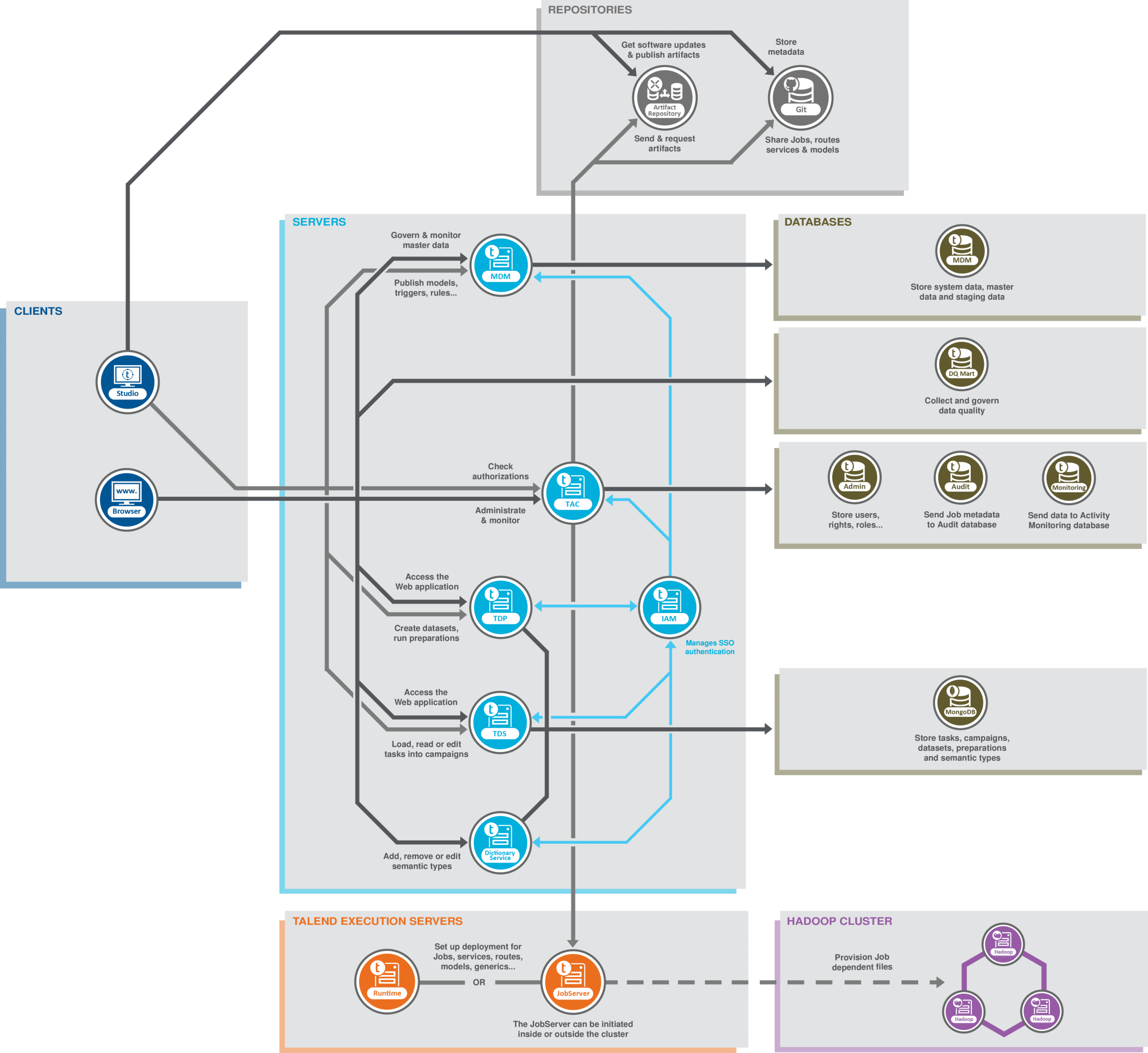
How Talend Data Fabric Works with Data
Talend Data Fabric covers several stages of data processing—from connecting data sources to validating, certifying, and delivering prepared data to consumers. Data quality and data governance can be integrated directly into the data preparation process, rather than performed separately after integration is complete.
| Stage | What’s going on? | Features Talend Data Fabric |
| Data Integration | The data comes from corporate and external sources | Connecting data sources, loading data, ETL/ELT, data pipelines |
| Transformation & Preparation | The data is presented in a format suitable for further use | Mapping, transformation, cleansing, enrichment, and reusable data preparation flows |
| Data Quality | The status and suitability of the datasets are being checked | Profiling, validation, standardization, troubleshooting, Qlik Talend Trust Score™ |
| Data Inventory | The team is conducting a dataset inventory to identify, understand, assess the quality of, and reuse data. | Smart Discovery, semantic types, validation rules, profiling, tags, annotations, Qlik Trust Score, validated and certified datasets |
| Data Stewardship | The data is verified and certified by the appropriate specialists | Task review, supervised verification, correction, certification, audit trail |
| Security & Governance | The use of corporate information is monitored | Role-Based Access, Masking, Access Rules, and Usage Control |
| API & інтеграція застосунків | Data is integrated into operational interactions between systems, including orchestration, mapping, transformation, validation, and format harmonization between backend systems. | API Development (REST, SOAP), CI/CD, Microservices, SAP Integration |
Data Integration: Talend ETL and Talend Studio
Data Integration is the core level of data processing in Talend Data Fabric. Talend Studio is used to develop integration processes—an environment where professionals create ETL/ELT processes to connect sources, load, transform, and transfer data between systems.
Instead of writing all the integration logic manually, developers can build processes using pre-built components, configure mappings and transformations, define processing rules, and set the sequence of operations. This makes it possible to work with both relatively simple data flows and complex enterprise integrations between databases, applications, files, SaaS services, and other sources.
Talend Studio is essentially a development environment for creating and maintaining integration logic, while other features of Talend Data Fabric complement this process with tools for Data Preparation, Data Quality, Data Stewardship, and Governance.
Data Preparation: Self-Service
Talend Data Preparation is a self-service tool for quickly cleaning, preparing, and transforming data without the need to write complex ETL code. Users can independently complete the entire preparation process: identify issues in the data → clean it → transform it → and prepare it for analysis or further integration. The tool can be used not only by technical specialists, but also by business users, analysts, and BI professionals.
Data Quality: Evaluate Data Before Using It
One of the platform’s key features is the Qlik Talend Trust Score™. For each dataset, a score is generated that takes into account the quality, popularity, and usage of the data. This provides users with additional context for selecting a dataset, rather than forcing them to evaluate it based solely on its name or technical description.
Smart Discovery complements this approach: the platform scans sources and automatically creates dataset profiles, helping to quickly identify formats, patterns, and potential issues. Data quality is controlled using semantic types and validation rules, which allow data to be checked for compliance with specified requirements.
Thus, the question “Where is the data I need?” is supplemented by two even more important ones:
“What does this dataset contain?” → “Can it be trusted?”
Data Management: Control Doesn’t End with Automated Verification
Not all quality-related issues can or should be resolved automatically. Talend Data Fabric supports a Data Stewardship feature, which allows data verification and correction tasks to be assigned to responsible specialists in the form of structured tasks.
Data stewards can review and correct discrepancies, use recommendations and rule templates, and the system tracks approval statuses and the certification history. Dashboards allow users to monitor the progress of reviews and view a list of unresolved data issues.
This establishes a link between automated data quality assurance and organizational accountability: a problem can not only be identified, but also assigned to a specific person in charge, monitored to ensure it is resolved, and the result documented.
APIs and Complex Integration Scenarios
Talend Data Fabric is not limited to ETL/ELT pipelines for analytics platforms. The solution supports API development and application integration, including CI/CD deployment and containerized microservices.
For complex integrations, mapping and transformations are available for JSON, AVRO, SAP IDoc, and XML, as well as support for industry-specific formats and standards, such as HL7 and EDI. This allows the platform to be used wherever traditional data integration needs to be combined with APIs, applications, and B2B exchange.
Talend Data Fabric and Qlik Talend Cloud: What’s the difference?
Talend Data Fabric and Qlik Talend Cloud address similar challenges in the areas of data integration, data quality, and data management, but are designed for different deployment models and architectural requirements.
Talend Data Fabric is a client-managed platform that allows you to deploy and control an integration environment within your own infrastructure. It combines data integration, data quality, data governance, and application integration capabilities, and supports working with data both in the cloud and on on-premises servers. This makes the solution ideal for organizations where some systems and data must remain within the corporate network or where a complex hybrid architecture is used.
Qlik Talend Cloud, on the other hand, is built on the Qlik Cloud infrastructure and provides a unified environment for integration, quality assurance, and data management. The platform supports hybrid scenarios involving both cloud-based and on-premises sources and target systems. The platform is designed to build managed data pipelines, deliver reliable data, and support modern analytics and artificial intelligence scenarios.
| Talend Data Fabric | Qlik Talend Cloud | |
| Model | Client-managed | Qlik Cloud |
| Main Focus | Data integration, data quality, data management, application integration | Data integration, data quality, data management, data pipelines, and data ready for use in artificial intelligence systems |
| Infrastructure | The Company’s Environmental Monitoring | Qlik Cloud Service |
| When this is particularly relevant | Local and Complex Hybrid Environments, Infrastructure Management Requirements | “Cloud-first” architecture, modern analytics, and AI with support for cloud platforms and on-premises data sources |
Therefore, when choosing between platforms, you should not start by comparing the number of features. It is more important to determine where integration processes should take place, which systems will remain on-premises, what requirements exist regarding infrastructure control and management, and what the company’s cloud strategy is.
For more information about the solution’s features and components, visit the Talend Data Fabric page.
When Should a Company Consider Talend Data Fabric?
Talend Data Fabric is best used in situations where the task goes beyond the scope of a single ETL process. Typically, the need for such a platform arises when a company is dealing simultaneously with a complex integration architecture, various environments, and heightened requirements for data quality and control.
Talend Data Fabric is worth considering if:
- Some systems and data remain on-premises, while others are already running in the cloud—and it is necessary to maintain a unified hybrid data architecture.
- The number of data sources, integrations, and data pipelines is growing, and supporting them requires more and more resources.
- ETL/ELT processes are built using various tools or a significant amount of custom code, which makes them difficult to develop and maintain.
- Data quality is verified manually, either separately from the integration process or only after incorrect data has already entered the analytics systems.
- It is necessary to ensure not only data movement but also data profiling, cleansing, validation, data governance, and stewardship processes.
- Companies require APIs and application integration alongside traditional data integration scenarios.
- There are requirements regarding data storage, access, encryption, masking, transparency, and controllability of the integration environment.
When control over infrastructure is the key factor
Another argument in favor of Talend Data Fabric is its client-side management model. It allows companies to maintain control over the execution environment for integration processes, which can be critical for complex hybrid architectures and internal requirements for data placement and management.
In such scenarios, Talend Data Fabric enables you to combine data integration, data quality, data governance, and application integration within a managed enterprise environment—a significantly broader range of tasks than what a standalone ETL tool can provide.
From Data Integration to Reliable Data
The value of Talend Data Fabric lies not in individual ETL processes, data quality assurance, or cataloging per se. The platform enables you to integrate these tasks into a single, managed data lifecycle—from connecting to data sources and transforming data to verifying its quality, controlling access, and leveraging it for analytics, applications, and artificial intelligence.
As a result, the company receives not just transferred data, but “trusted data”—prepared, verified, and managed datasets for which the origin, rules of use, and accountability are clearly defined.
This approach is particularly well-suited for architectures in which data integration has already become an ongoing corporate process and must scale along with the number of sources, systems, and use cases.
RBC Group helps assess your current data architecture, determine the optimal deployment model, and select the appropriate Talend Data Fabric configuration to address specific integration and data quality challenges.
Discuss your data architecture and the possibilities for implementing Talend Data Fabric in an enterprise environment with RBC Group experts.
 6
As a BI analyst, Cash Flow helps identify cash flow gaps in a timely manner, forecast liquidity, and evaluate financial scenarios to support informed management decisions.
 17
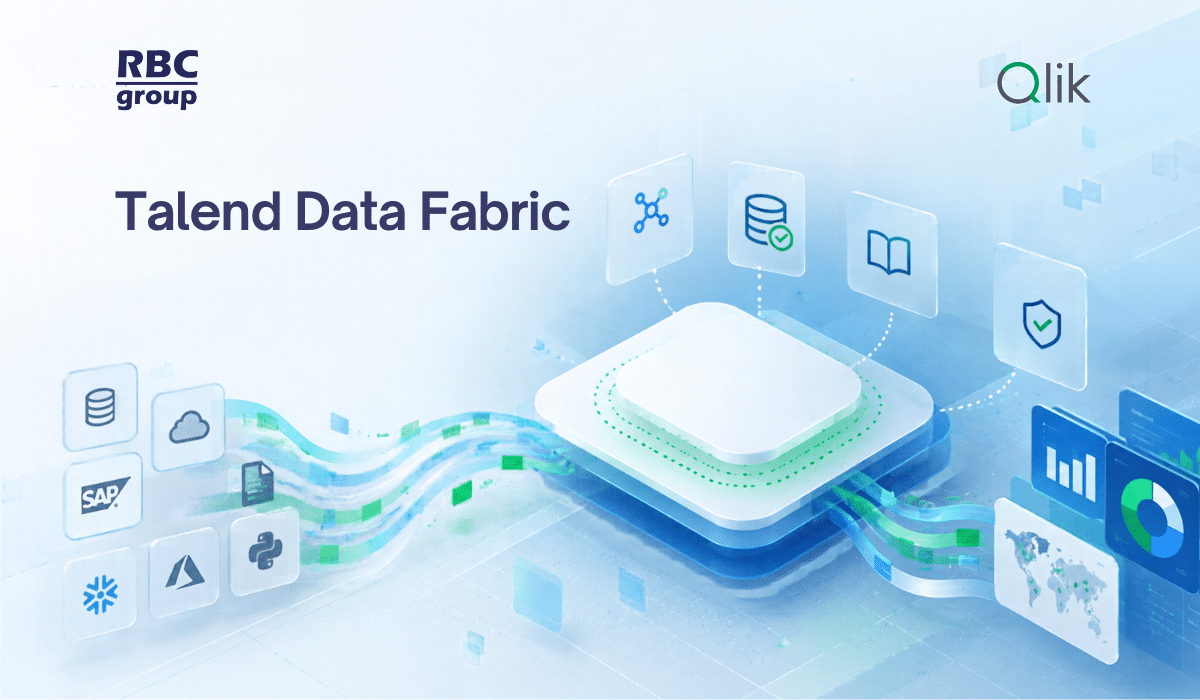
How can you combine integration, preparation, quality control, and data management into a single platform? Let’s explore the capabilities of Talend Data Fabric, its key tools and use cases, as well as how it differs from Qlik Talend Cloud.


