


Qlik Replicate and Open Lakehouse: Capabilities and Cost Savings
 1
For companies already using Qlik Replicate, expanding analytics and AI initiatives raises a practical question: how can they make data available for new use cases while preserving their existing replication processes and investments?
Replicate Source for Open Lakehouse, a new feature in Qlik Talend Cloud, enables existing Qlik Replicate deployments to deliver data into Apache Iceberg tables through Qlik Open Lakehouse. It requires no upgrade to the existing Replicate installation, no migration of existing pipelines, and no additional ingestion layer.
How the Open Lakehouse Integration Works
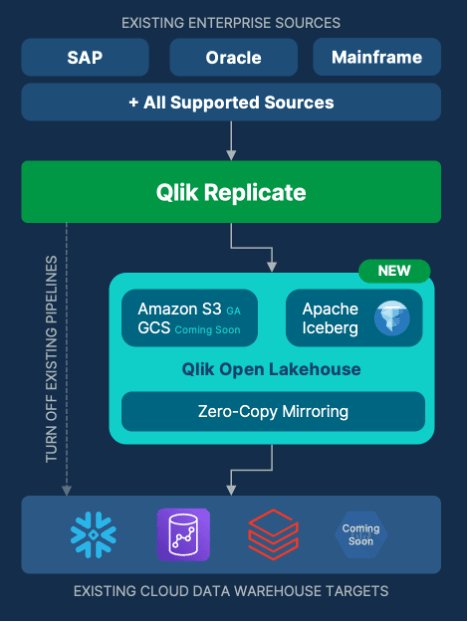
The integration starts with the cloud object storage target where Qlik Replicate writes data from enterprise sources. Qlik Open Lakehouse takes over from there:
- Qlik Replicate delivers data to cloud object storage. Sources can include mainframe systems, SAP, and traditional relational databases.
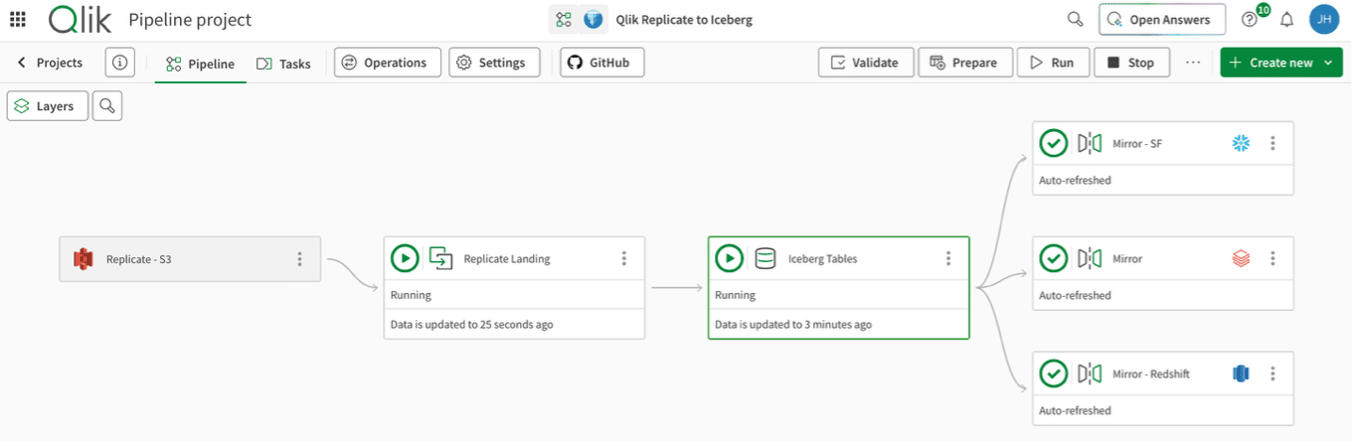
- A Replicate landing task reads the replication output. This new task type natively understands the data written by Replicate.
- Open Lakehouse continuously writes and optimizes Apache Iceberg tables. Once configured, the process runs automatically.
Data delivery therefore extends beyond CSV or Parquet files in object storage to a managed Iceberg lakehouse. For companies with complex source environments, this means existing connections to business-critical systems can supply data to a new analytics environment.
What Apache Iceberg Offers Businesses
Apache Iceberg is an open table format supported by Snowflake, Databricks, Amazon Redshift, Google BigQuery, and other modern query engines. It allows multiple platforms to query the same tables without copying the data. Companies can select tools for specific needs—reporting, forecasting, or machine learning—while reducing dependence on a single vendor.
Beyond interoperability, Iceberg provides:
- ACID transactions to maintain data integrity and consistency during writes and updates.
- Schema evolution to accommodate changes to table structures as requirements develop.
- Time travel to access previous table states, investigate changes, and reproduce analytical results for a particular point in time.
These capabilities help teams adapt their analytics environment as business needs change and verify the data behind earlier results. The open format also provides a foundation for AI initiatives, while data quality and suitability for each use case still require separate assessment and controls.
Where the Cost Savings Come From
Qlik Open Lakehouse offers potential savings in three areas.
Automated maintenance. The Adaptive Optimizer automatically handles file compaction, file sizing, and orphaned file management. This reduces manual maintenance work and gives data engineers more time to develop analytics solutions.
Data access through zero-copy mirroring. Iceberg tables can be made available in Snowflake, Databricks, Google BigQuery, or Amazon Redshift without cloud data warehouse ingestion fees. For companies running direct Replicate-to-Data Warehouse pipelines, this can reduce ingestion costs as data volumes grow. The savings relate specifically to ingestion; data storage and analytical queries have their own costs.
A different compute and billing model. Iceberg ingestion and optimization run on compute clusters using lower-cost spot instances within the customer’s virtual private cloud (VPC). Billing is based on compute core-hours rather than data volume. This model can be cost-effective for workloads that frequently deliver changes through Change Data Capture (CDC).
According to a Nucleus Research study cited by Qlik, customers that moved ingestion workloads from Data Warehouse compute to Qlik Open Lakehouse reduced their ingestion compute costs by up to 70%. This figure does not represent savings across the entire infrastructure budget. Results for an individual company depend on its workloads and configuration.
How to Assess the Business Case
Start by comparing the cost of your current data delivery architecture with the Open Lakehouse model. Consider the frequency and volume of CDC changes, the compute resources used for ingestion, the engineering time spent on maintenance, and the platforms that will access the Iceberg tables.
Pipelines that supply the same source data to multiple analytics systems, or where Data Warehouse ingestion costs are rising, are useful starting points. This comparison can help identify which pipelines to connect first and estimate the potential savings.
Learn more about enterprise data replication and delivery on our Qlik Replicate page.
 3
RBC Group has been awarded Qlik Support Expert Partner status—a recognition of our expertise and a new opportunity to provide technical support to our clients.
 1
How to use data from Qlik Replicate in the Apache Iceberg open architecture without restructuring existing workflows. The capabilities of the Open Lakehouse and cost savings in data processing.


