


Qlik Talend Cloud: Modern Data Integration for Analytics and AI
 21
The challenge in modern data architecture is rarely a lack of data. More often, organizations have an abundance of it, distributed across SAP, ERP, CRM, databases, SaaS applications, mainframe systems, files, and cloud platforms. While one team builds a data warehouse, another prepares data for machine learning, and a third develops AI applications, IT must ensure that data arrives on time, is transformed and consolidated in a shared repository, passes quality checks, and remains governed throughout its journey to the consumer.
Qlik Talend Cloud addresses this challenge by combining data integration, transformation, data quality, and data governance. It enables organizations to build governed data pipelines and deliver current, validated data for data warehouses, lakehouses, BI, machine learning, and AI.
Qlik emphasizes five requirements for a modern data platform:
- Timeliness: moving and updating data in real time or with minimal latency.
- Quality: built-in data quality capabilities.
- Governance: metadata management, data lineage, and data governance.
- Scalability: support for large numbers of heterogeneous sources and target systems.
- AI readiness: providing validated data prepared for AI use cases.
This differs from an approach that relies on separate tools for replication, ETL/ELT, data quality, API integration, and governance. In Qlik Talend Cloud, these processes can form part of a unified architecture, from connecting a source to publishing prepared data for downstream use.
Below, we explain how this data journey works, the technical mechanisms involved at each stage, and the business needs the architecture addresses.
What Qlik Talend Cloud Is and How It Works
Qlik Talend Cloud is a cloud platform for data integration, transformation, quality, and governance. It supports hybrid environments, where sources and target platforms may reside in the cloud or on-premises. The platform enables an end-to-end process, from extracting data from enterprise systems to preparing it for analytics, machine learning, and AI.
At a high level, the data flow can be represented as follows:
Data sources → Full Load / CDC → Data pipelines → Transformation → Data Warehouse / Lakehouse / Data Products → Data Quality & Governance → BI / ML / AI
The connections between these stages are essential. Data is not simply copied from one location to another. Along the way, it can be transformed to fit a target model, checked for quality, traced to its source, and prepared for a specific use case.
1. Connecting Sources and Loading Data
The platform supports heterogeneous IT environments, including databases, SAP, mainframe systems, SaaS applications, and other enterprise sources. Supported data platforms include Snowflake, Google BigQuery, Amazon Redshift, Microsoft Fabric, Azure Synapse Analytics, Microsoft SQL Server, Databricks, and Open Lakehouse based on Apache Iceberg.
Qlik Talend Cloud also connects to on-premises and private cloud data sources through Qlik Data Movement Gateway.
Qlik uses transaction log-based Change Data Capture, or log-based CDC, to automate data movement and replication in real time or with minimal latency through:
- Full Load: the initial load of the complete dataset.
- CDC (Change Data Capture): the subsequent capture and incremental delivery of changes from the source.
2. Building and Automating ELT and ETL Data Pipelines
Once sources are connected, Qlik Talend Cloud enables teams to build governed ELT and ETL pipelines that automate data movement, processing, preparation, and the creation of target structures, including automatic incremental updates.
The platform handles a substantial share of routine technical work. It automatically creates and updates target data structures and schemas by generating the required SQL. Engineers can focus on transformation logic rather than writing standard SQL statements to create tables, load data, and update records. The resulting structures and data model can also be used to automate data mart creation.
For teams taking a code-first approach, Qlik Declarative Pipelines support the definition, configuration, and deployment of Qlik Talend Data Integration projects through YAML configuration files. This approach allows teams to use AI tools such as Claude Code or GitHub Copilot to help write and maintain configurations, making pipeline development and management more flexible and easier to automate.
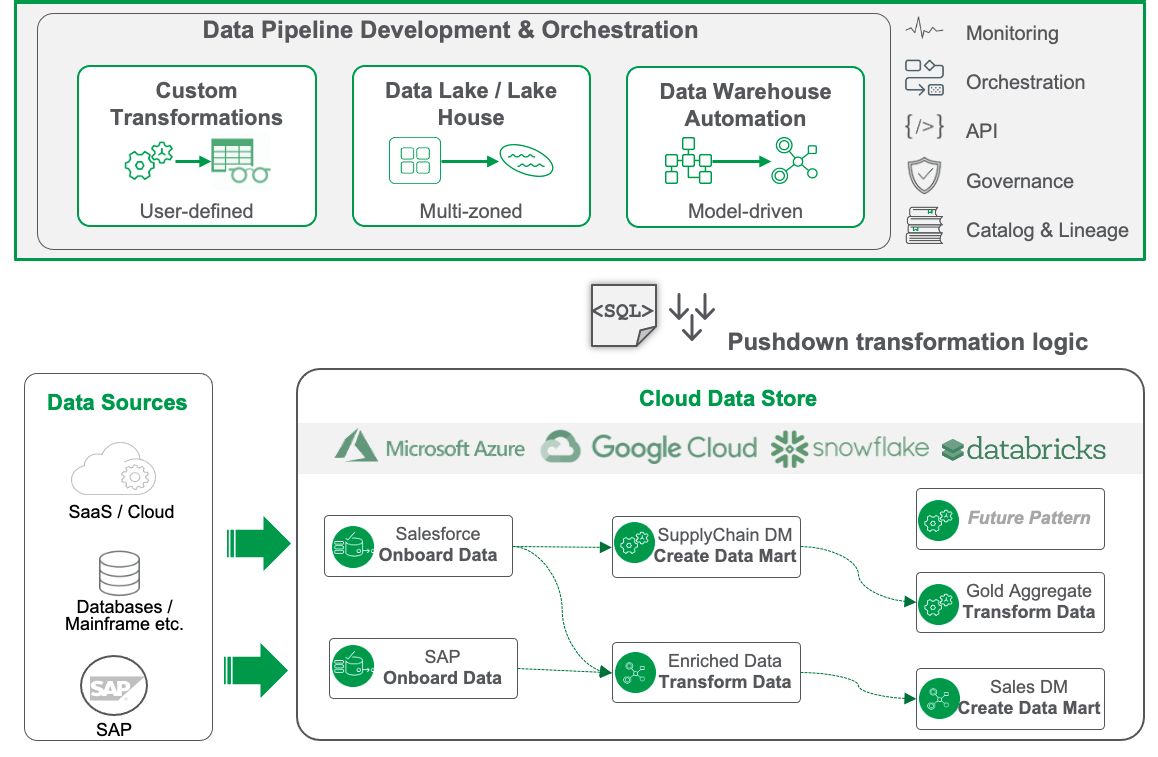
Qlik Talend Cloud supports:
- Visual transformation design with SQL generation.
- SQL transformations and AI-assisted SQL generation.
- Automated creation of star-schema data marts.
- Historical data tracking using Slowly Changing Dimensions Type 2 (SCD Type 2).
- Pipeline development for Open Lakehouse based on Apache Iceberg.
- Reverse ETL to deliver prepared and validated data from analytics platforms to operational systems.
The result is data prepared for a specific analytical or business purpose, rather than simply a copy of the source tables.
3. Data Quality, Context, and Governance
The next step is to establish whether the data can be trusted.
Qlik Talend Cloud enables teams to register datasets from different sources in the catalog, including sources within an on-premises corporate network, through a direct access gateway that provides a secure data connection. Datasets can also be registered automatically as ELT pipelines are created.
The platform supports semantic types, data quality rules, profiling, documentation, business glossaries, data lineage, and impact analysis. These capabilities help teams understand how changes may affect analytical applications and other downstream uses.
Prepared data can be organized into Data Products: governed datasets that bring together the data itself, semantic types, quality rules, documentation, and business glossaries. Teams can assess their quality using Qlik Trust Score and assign owners and roles. In addition to direct access on the target platform, Qlik Cloud allows Data Products to be published through OData APIs for external applications and services.
Qlik Answers and Qlik MCP extend the opportunities for AI-assisted data management. AI can support tasks such as creating Data Products, analyzing quality, generating validation rules and business glossaries, and preparing enterprise data for use.
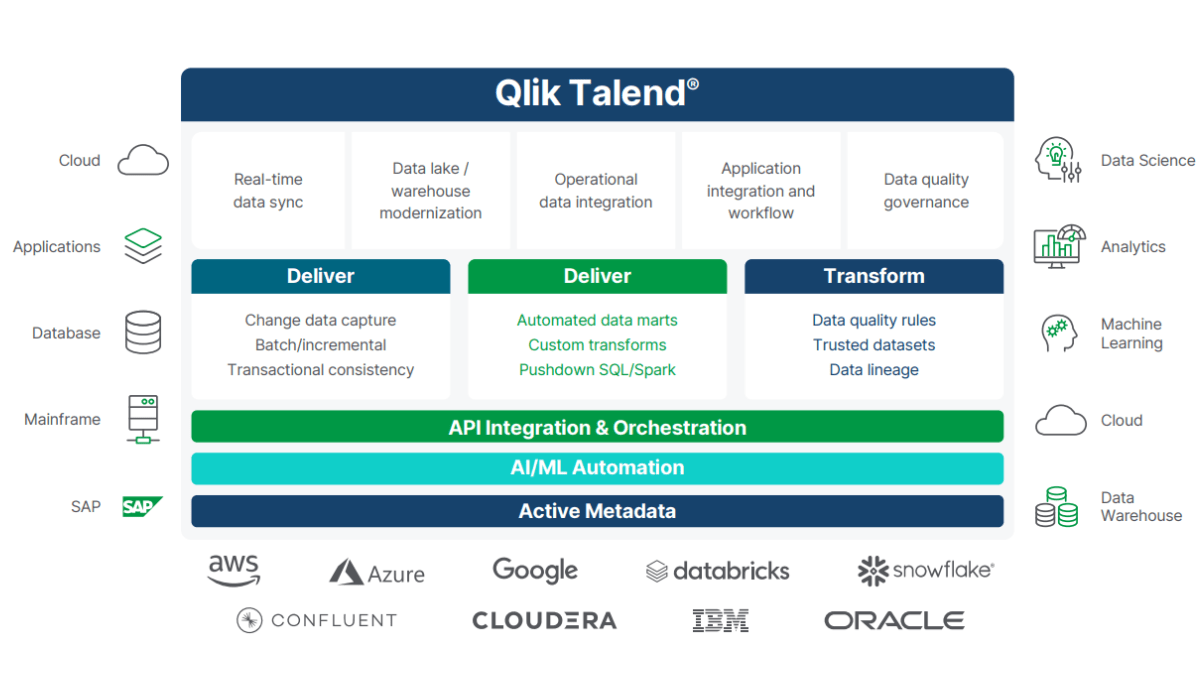
Qlik Talend Cloud therefore addresses a broader need than data integration alone: establishing a controlled path from operational systems to current, transformed, validated data for analytics and AI.
What Business and Technical Needs Does Qlik Talend Cloud Address?
The platform’s capabilities are best understood through practical scenarios: synchronizing systems, migrating to a new platform, preparing data for analytics, managing quality, or incorporating data into operational processes.
Qlik Talend Cloud covers several core areas of data integration, from CDC and data warehouse modernization to SAP integration, data quality, and APIs.
Key Qlik Talend Cloud Use Cases
| Objective | How Qlik Talend Cloud Works | Practical result |
| Real-time Data Synchronization and Replication | The CDC tracks changes in sources and transmits them to target systems without having to re-upload the entire dataset | Real-time data for operational analytics, reporting, and client systems |
| Creating a Data Warehouse / Lakehouse | Automates data loading using CDC, the creation of data pipelines, and data showcases | Less Manual Work When Migrating and Developing Data Warehouses, Data Lakes, and Lakehouses |
| Data Quality & Governance | Profiling, quality rules, metadata, data lineage, and data governance are integrated into the data preparation process | Quality and Data Origin Control Before Using Data in BI, ML, and AI |
| SAP Data Integration | SAP data is integrated with other corporate sources and transferred to analytics platforms | Sharing data from SAP, CRM, SaaS, databases, and other sources within an analytics architecture |
| Application Integration, AI, and APIs | APIs and integration processes enable data exchange between enterprise applications and systems, and LLM models can be used to process data directly within integration processes. | Using data not only for analytics but also for system and service integration, as well as AI LLM models from OpenAI, Amazon Bedrock, Anthropic, Google Gemini, and Ollama |
| Operational Data Integration | Data movement and transformation, API integration, and orchestration are combined into a single integration process | Data Transfer and Usage in Operating Systems and Subsequent Processes |
1. Real-Time Data Synchronization and Replication
Qlik Talend Cloud uses CDC to track changes at the source and deliver them to the target platform without reloading the entire dataset. This keeps target systems updated in real time or with minimal latency.
The platform also automates source-to-target schema migration and target table creation, including heterogeneous scenarios, such as Microsoft SQL Server as the source and PostgreSQL as the target.
One potential use is maintaining a data replica as a fallback copy that can be brought into use if the primary system fails. These capabilities can also automate a complete data migration between systems, including the creation of target tables.
This approach is relevant to operational analytics and other use cases where low latency between the source and the consuming system is critical.
2. Modernizing Data Warehouses, Data Lakes, and Lakehouses
Modernizing a data platform involves more than moving information to a new environment. Teams must also establish ongoing updates, transformations, analytical models, and data marts.
Qlik Talend Cloud automates this process, from ingestion and CDC to transformations and the creation of structures ready for analytics. It supports modern data warehouse and lakehouse architectures, including Snowflake, Databricks, Microsoft Fabric, Google BigQuery, Open Lakehouse based on Apache Iceberg, and other cloud data platforms.
Automation extends beyond delivery:
- Data pipelines: governed movement and incremental updates from the source to the target environment.
- SQL pushdown: execution of transformations using the target platform’s processing capabilities and compute resources.
- Data marts: automated creation of analytical structures, including star schemas.
- Historical data tracking: support for Slowly Changing Dimensions Type 2.
- Open Lakehouse: use of Apache Iceberg as an open table format for lakehouse architectures.
For IT teams, this reduces manual development and the maintenance of individual scripts and processes. For the business, it simplifies the addition of new sources and preparation of data for new analytical needs without rebuilding the integration architecture each time.
Qlik Talend Cloud can therefore support both migration to a new data platform and its ongoing development as new sources, data models, and use cases emerge.
3. Data Quality and Data Governance
Delivering data is only part of the task. Organizations also need to understand whether it can be trusted, especially when the same datasets support management reporting, BI, machine learning, and AI.
Qlik Talend Cloud incorporates data quality directly into preparation processes. Teams can profile data, apply quality rules, identify issues, and monitor its condition before downstream systems use it.
Metadata management, data lineage, and governance provide the necessary context: where data originated, which transformations it underwent, and which downstream objects and processes depend on it.
IT teams can therefore control data delivery, quality, provenance, and suitability for further use.
4. SAP Data Integration and Modernization
SAP remains a key source of enterprise information for many large organizations. To use that information more broadly, companies often need to combine it with data from CRM systems, databases, SaaS applications, and other business systems.
Qlik Talend Cloud supports SAP data integration and modernization, delivering the required data to data warehouses, lakehouses, cloud data platforms, and other target environments.
This allows SAP data to be used alongside other enterprise information in operational processes, analytics, and AI applications.
For more information about the technologies and components used to build an enterprise data platform, visit our data integration solutions page.
5. Application, AI, and API Integration
Not every integration process ends in a data warehouse or BI application. Data may be needed by another application, service, or operational process.
Qlik Talend Cloud supports application and API integration, including API development and integration processes connecting enterprise systems. This makes it possible to use data in application interactions, trigger downstream processes, and deliver information where a specific operation requires it.
Teams can also incorporate LLM capabilities from OpenAI, Azure OpenAI, Amazon Bedrock, Anthropic, Google Gemini, and Ollama into integration processes and ETL pipelines to build agentic AI solutions for working with data.
6. Operational Data Integration
Operational integration is needed when information must be exchanged between systems and used in current business processes, rather than simply accumulated for later analysis.
Qlik Talend Cloud combines data movement, transformation, API interactions, and orchestration within one integration process. For example, newly received or changed data can be processed, delivered to another application, and used to trigger the next operation.
The platform supports integration patterns ranging from CDC and data warehouse development to API integration and operational data exchange. This allows organizations to use a shared integration platform for both analytical and operational needs.
Qlik Talend Cloud for AI: RAG, LLMs, and Agentic Data Engineering
Knowledge Marts for RAG
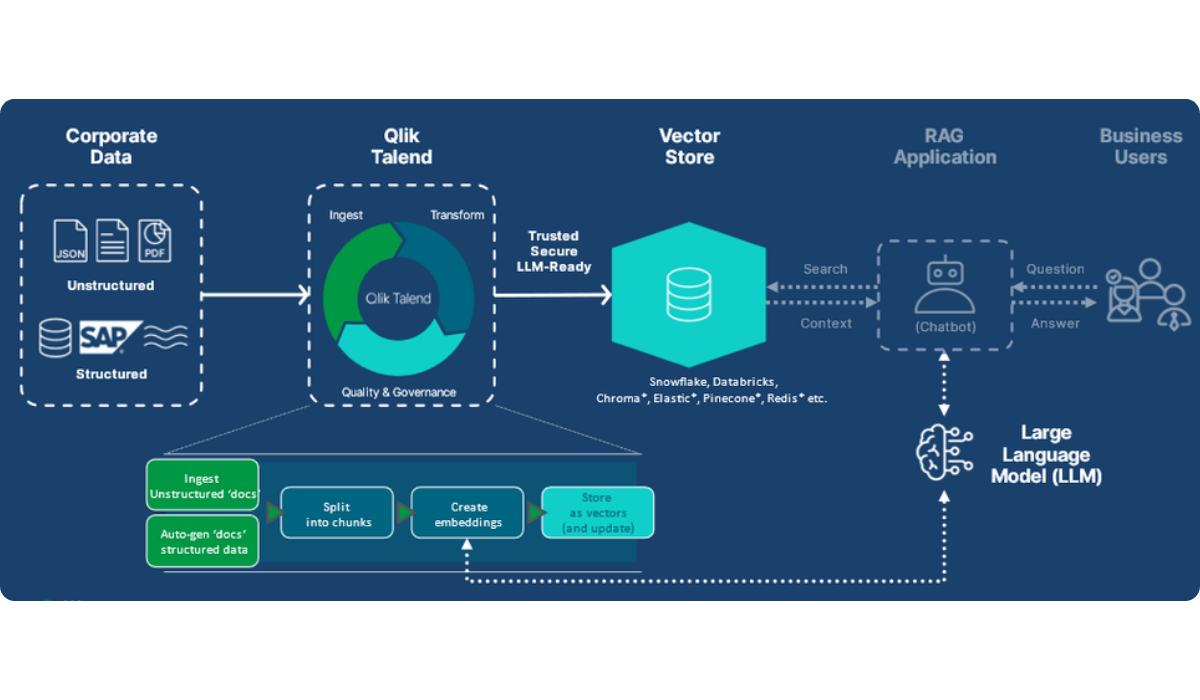
Giving generative AI access to enterprise data is not enough. To use that data in Retrieval-Augmented Generation (RAG), it must be extracted from sources, prepared, converted into a form suitable for embedding models, and delivered to a vector store.
Qlik Talend Data Integration supports pipelines that build Knowledge Marts from both structured and unstructured enterprise data. Preparation can involve CDC, advanced transformations, document chunking, and models that generate vector embeddings.
At a high level, the architecture follows this sequence:
Enterprise data → Data pipeline → Preparation and transformation → Embeddings → Vector store → Knowledge Mart → RAG / Generative AI
Structured Data
Relational databases can serve as sources for structured information. A document model is built from that data, after which the process can include:
- Creating JSON documents according to the configured data model.
- Generating document embeddings using the selected embedding model.
- Loading vectors into a vector store.
- Processing new and changed data incrementally through the pipeline, including through CDC.
- Updating the vector store when information changes in the source system.
Embedding generation can use models available through OpenAI, Azure OpenAI, Amazon Bedrock, Databricks LLM, and Snowflake Cortex LLM services.
Unstructured Data
Knowledge Marts can also be built from enterprise documents, including PDF, TXT, and Microsoft Word DOCX files.
Qlik Talend Data Integration can retrieve these files from FTP servers, SMB file shares, Microsoft OneDrive, SharePoint, and object storage. Documents are then divided into smaller chunks, embeddings are generated for those chunks, and the results are delivered to a vector store.
The vector storage layer can use OpenSearch, Elasticsearch, Pinecone Vector Search, and the capabilities of Snowflake Cortex and Databricks Mosaic.
The process can run on a defined schedule to keep the knowledge base updated as enterprise sources change.
Qlik Talend Data Integration therefore supports a key infrastructure layer in a RAG architecture: acquiring and updating enterprise data and turning it into a vector knowledge base that generative AI can use to retrieve relevant context and generate responses.
Qlik Talend Agentic Routes: AI Within Data Pipelines
Qlik Talend Agentic Routes extend integration capabilities by incorporating LLMs and AI agents directly into data pipelines. Data engineering teams can include LLM calls, RAG processes, and agent orchestration in integration tasks without building a separate AI infrastructure.
Agentic Routes support both cloud-based and locally deployed LLM environments:
- Cloud-based: OpenAI, Anthropic Claude, Google Gemini, and Amazon Bedrock.
- Local: Ollama-based deployments and models such as Mistral, Gemma 3, Phi 4, and other locally hosted models.
In practice, this allows AI processing to run during data transformation. Teams can use LLMs for sentiment analysis, content classification, entity extraction, or data quality operations without handing the task over to a separate AI platform.
Agentic Routes also support RAG pipelines that deliver enterprise data to vector stores and build custom knowledge bases. Target platforms include Pinecone, MongoDB, Snowflake, and Databricks in cloud environments, as well as Milvus, Oracle, and MongoDB for on-premises use cases.
Beyond LLM calls and RAG, Agentic Routes support more advanced orchestration:
- Event-driven AI orchestration: a data event can trigger an AI agent action directly from an integration process.
- Conversational AI: context can be maintained across multiple requests to support multistep natural-language interactions.
- MCP client capabilities: integration processes can call tools exposed by MCP-compatible servers, including Qlik MCP Server.
A pipeline can therefore move and transform data, use LLMs to process it, trigger AI agents, and interact with external tools through MCP. This extends Qlik Talend Cloud’s role from traditional integration to AI-enabled data processes.
Agentic Data Engineering
Another area of development is the use of AI agents to support data engineering and management activities.
The Data Products Agent, Data Quality Agent, and Glossary Agent, powered by Qlik Answers, help automate tasks such as creating Data Products, analyzing data quality, and generating validation rules and business glossaries.
These agents take on repetitive work while keeping specialists in control of the process.
For businesses, this means data preparation for AI can scale as the number of sources and use cases grows, without a proportional increase in manual effort.
When to Consider Qlik Talend Cloud
The need for a platform of this kind typically arises when the number of sources, integration processes, and data requirements makes separate tools and scripts increasingly difficult to maintain.
Consider Qlik Talend Cloud if your organization:
- Works with numerous enterprise, cloud, SaaS, and SAP sources.
- Needs CDC replication and real-time integration in place of periodic batch loads.
- Is building or modernizing a data warehouse, data lake, or lakehouse.
- Is developing an architecture based on Snowflake, Databricks, Google BigQuery, Microsoft Fabric, or other cloud platforms.
- Devotes substantial resources to manually developing and maintaining data pipelines.
- Uses separate integration, data quality, API integration, and governance tools and wants to reduce technology stack complexity.
- Needs data quality, lineage, and governance controls within data preparation processes.
- Is preparing enterprise data for machine learning, RAG, and AI.
Want to understand how Qlik Talend Cloud could fit your architecture? Request a demo or discuss your requirements with RBC Group’s experts.
For more information about platform capabilities, components, and use cases, visit our Qlik Talend Cloud and data integration solutions pages.
 5
RBC Group has been awarded Qlik Support Expert Partner status—a recognition of our expertise and a new opportunity to provide technical support to our clients.
 2
How to use data from Qlik Replicate in the Apache Iceberg open architecture without restructuring existing workflows. The capabilities of the Open Lakehouse and cost savings in data processing.


